
South Tampa neighborhood guide
Palma Ceia
Central South Tampa, between Dale Mabry Highway and the Selmon Expressway. Founded in 1903, home to a private golf club since 1916, and still laid out on its original Spanish-named streets.
Where it sits
Between Dale Mabry and the expressway
Palma Ceia sits in the middle of South Tampa. The neighborhood association's boundary runs from Dale Mabry Highway on the west to the Lee Roy Selmon Expressway on the east, and south to El Prado Boulevard. Palma Ceia West, a separate neighborhood with its own association, continues on the other side of Dale Mabry.
Bay to Bay Boulevard crosses it east to west and MacDill Avenue north to south. Where they meet is the neighborhood's commercial district, about a half-mile walk from Bayshore Boulevard. Away from those two streets, the residential blocks are paved in historic brick with granite curbs, under large oaks.
The expressway, built in the 1970s along the old Port Tampa railroad spur, separated the neighborhood from Bayshore. The part east of it became a separate neighborhood, Bayshore Gardens.
- West edge
- Dale Mabry Highway
- East edge
- Selmon Expressway
- South edge
- El Prado Boulevard
- Main crossing
- Bay to Bay and MacDill
- To Bayshore
- About a half-mile walk
- Next door
- Palma Ceia West, Bayshore Gardens
How it was built
Madrid, a spring, and a golf club
Tampa attorney Thomas Palmer and his wife, Ruby, began developing the area in 1903 under the name Madrid. Near the bay was a natural spring, Palmera Spring, and its spring-fed pool drew visitors from downtown, about three miles away by streetcar along Bayshore.
No record settles how Madrid became Palma Ceia. The usual explanation, given on the county's historical marker, is that the name joins Palmer with Terra Ceia, the Manatee County island.
The original street names survive on the residential blocks — Empedrado, Santiago, San Miguel, and others. The main roads were renamed as the area grew: Bay to Bay Boulevard was Covadonga Street, and MacDill Avenue was Lisbon Avenue.
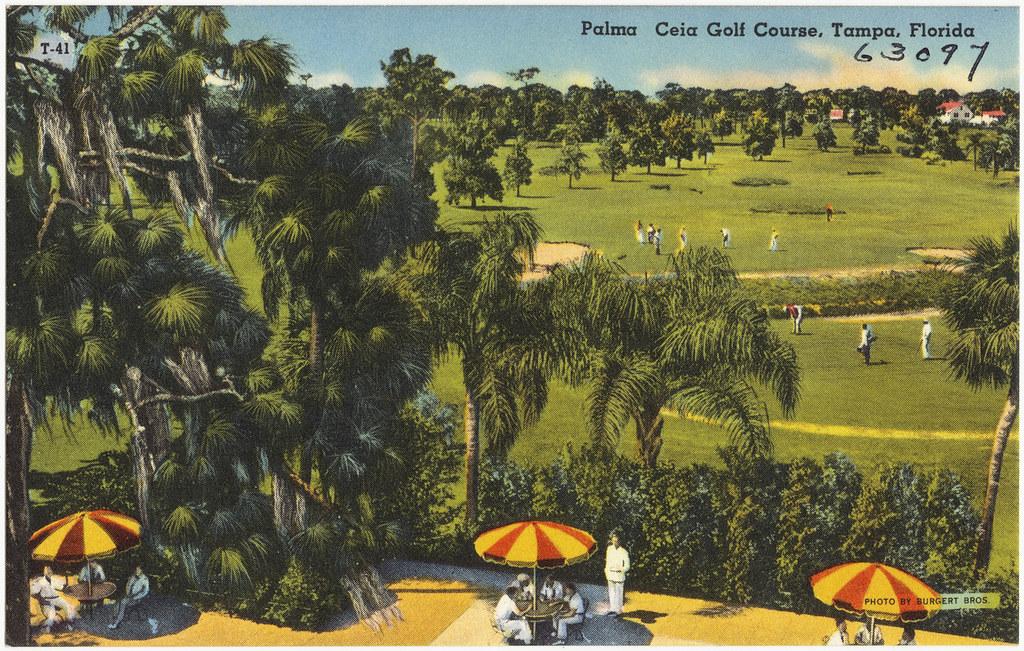
In 1916 a group of Tampa businessmen leased 100 acres of pine woods for a golf course and founded Palma Ceia Golf & Country Club. Tom Bendelow routed the original course through the trees, and Donald Ross reworked it in the 1920s. Dale Mabry Highway came through in the 1940s, and the City of Tampa annexed Palma Ceia in 1953.
- 1903
- Thomas and Ruby Palmer begin developing the area as Madrid.
- 1916
- Palma Ceia Golf & Country Club is founded on 100 leased acres.
- 1920s
- Donald Ross reworks the golf course.
- 1940s
- Dale Mabry Highway comes through.
- 1953
- The City of Tampa annexes Palma Ceia.
- 1970s
- The Selmon Expressway separates it from Bayshore.
Housing fabric
Every decade, on the original lots
Palma Ceia was built out over most of the twentieth century and is still being rebuilt, so a single block can hold an early bungalow or Mediterranean Revival house, a mid-century house, and a new two-story home on a lot that once held something smaller.
The blocks along Bay to Bay were platted in 50-by-100-foot lots, and the City's 2021 plan for that district found that most housing added there since 2010 was new single-family homes, with some townhomes and duplexes. Lot size and zoning set the limits on what can replace an older house.
Palma Ceia is not one of the City's local historic districts, so most changes to a house here do not go through historic design review.
- Original lots
- 50 by 100 feet on Bay to Bay
- Built
- Across the twentieth century
- Added since 2010
- Mostly new single-family homes
- Historic district
- No local designation
Named places
A closer look at Palma Ceia
- Palma Ceia Golf & Country ClubThe private club founded in 1916, north of Bay to Bay Boulevard, and home to the Gasparilla Invitational amateur tournament.
- Bay to Bay and MacDillThe commercial district at the crossing, sometimes called the Palma Ceia Design District: cafés, boutiques, and services. A 2002 sculpture by Marc DeWaele at the intersection marks it.
- Palma Ceia SpringThe site of the Palmers' spring-fed pool, near the present Garden Club on Bayshore Boulevard. It drew swimmers for years before it was closed over public health concerns.
- Palma Ceia WestThe neighborhood across Dale Mabry Highway, with its own association and boundary.
Access
Getting around from here
- Bayshore BoulevardAbout a half-mile walk east from Bay to Bay and MacDill.
- Downtown TampaNorth by Bayshore, MacDill Avenue, or the Selmon Expressway.
- Tampa InternationalNorth up Dale Mabry Highway, which runs along the neighborhood's western edge.
- The Pinellas sideSouth and west to the Gandy Bridge and St. Petersburg.
Before you buy here
Questions that are property-specific
The age of a house and its original systems, drainage on the lot, flood zone, and what zoning allows on a given lot vary block by block. Ashley raises them at the start and coordinates the people who answer them — inspectors, surveyors, insurance agents, and lenders. She does not give those opinions herself.
More of South Tampa
- South TampaThe wider guide: the two bays, Bayshore, and the corridors.
- Hyde ParkTampa's oldest surviving neighborhood, directly across the Hillsborough River from downtown. Laid out in small subdivisions between 1886 and the 1920s, and still largely standing.
- Davis IslandsTwo islands built from the floor of Hillsborough Bay in the 1920s land boom, at the mouth of the Hillsborough River, with one road crossing to the mainland at the foot of Bayshore Boulevard.
Palma Ceia
Selling here, or trying to buy here
Ashley lives in South Tampa and knows these streets firsthand. If you already own in Palma Ceia, a Private Home Strategy Review is the place to start. If you are trying to buy here, a conversation about which blocks and which kinds of house suit you will save weeks of touring.